
Back to News
Rural Oregon deserves a representative who will show up and fight for us: Chris Beck
October 15, 2026
Oregon’s 2nd District is huge. It covers more than 70,000 square miles and 20 of the state’s 36 counties, from The Dalles and Medford out to the Idaho line. It’s the only one where registered Republicans outnumber Democrats. Republicans have held the seat since 1981.
Voters have been loyal. But what has that loyalty bought them? After six years of Cliff Bentz, the answer looks like not much. He voted for a law that puts rural hospitals at risk; he’s stopped holding in-person town halls; and when it counts, he goes along with Washington.
Chris Beck, the Democratic nominee, is running to change that. He knows rural policy from the inside. He’s worked across party lines, and he’ll actually show up.
The rural healthcare crisis: How Bentz’s vote has endangered his constituents
Healthcare is the issue closest to home for most people in this district, and Bentz’s 2025 vote for H.R. 1 — the “Big Beautiful Bill” — is the clearest place where he and his constituents part ways.
The law cuts nearly $1 trillion in federal Medicaid funding over ten years, and Oregon stands to lose a large share of it. At the time, reporting put the state’s exposure at about $7 billion over a decade. The Oregon Nurses Association warned that as many as 280,000 people could lose Oregon Health Plan coverage.
That risk lands hardest in Bentz’s own district. He represents more than 705,000 Oregonians, and they lean on Medicaid more than most. More than half of Malheur County (where Bentz lives) is enrolled, the highest share in the state, and seven of the other nine counties are at 40% or above. One report on a Bentz town hall put the share of kids in his district covered by Medicaid at about 70%.
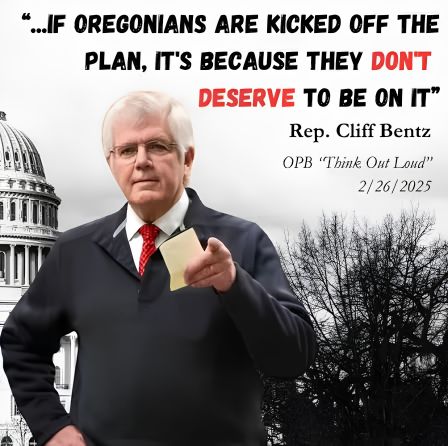
People told him. Gov. Tina Kotek called him personally and asked him to vote no. Former Gov. John Kitzhaber, whom Bentz has said he talks with regularly, wrote an open letter urging him to oppose the Senate version. Nurses and hospital advocates said the same. He voted yes anyway.
Bentz says the law doesn’t really cut Medicaid, but adds work requirements, and he points to a $50 billion rural health fund. But when he was asked how rural hospitals would be protected from the cuts, he admitted it would be a “challenge” and said Dr. Mehmet Oz, who runs Medicaid, had promised to help if hospitals ran into trouble. Rural hospitals run on small margins and can’t make payroll on a verbal assurance.
At one town hall — before he stopped holding them — a retired doctor from Medford told Bentz he was concerned about the future of rural hospitals if Medicaid coverage is harder for Oregonians to get. Bentz doubled down on the notion that Republicans aren’t cutting Medicaid, just imposing more requirements to access it.
To address these issues, Beck wants to repeal H.R. 1 as a first step. He says lost Medicaid reimbursements would sink many rural hospitals, and he’d like to see a national plan, built on the Oregon Health Plan, that covers basic and preventive care for everyone.
The cost of a “yes” vote: The local impact of stricter SNAP rules
Another consequence of Bentz’s yes vote on H.R. 1 is that the Oregon Department of Human Services (ODHS) has implemented stricter SNAP eligibility criteria, expanding the mandatory 80-hour monthly work requirement for adults ages 18 to 64 without young children. These sweeping changes have affected more than 313,000 Oregonians, resulting in the loss of food assistance for 70,000 vulnerable residents, including lawfully present immigrants and households receiving utility assistance.
Agriculture on the brink: Why closed-door sympathy won’t save our farms
The farming crisis in Eastern and Southern Oregon is severe, with nearly 70% of farms operating at a net cash loss and the state losing roughly one farm a day. In March, Bentz told U.S. Trade Representative Jamieson Greer, in a closed-door briefing for House Republicans, that Oregon farmers were having a “historically and truly disastrous year.” He cited weak prices, shaky markets, tariffs, and foreign competition across potatoes, onions, sugar, wheat, cherries, and more. Farmers told reporters that a key crop was selling near a ten-year low, barely covering what it costs to grow.
But a comment in a members-only room doesn’t help a farmer decide what to plant. People in the district should hear their representative say this out loud to voters and see him push back when federal policy makes things harder.
Squeezing rural wallets: Fighting the cash crunch on Main Street
The soaring cost of everyday life is a centerpiece of Beck’s campaign. For too long, skyrocketing fuel and fertilizer costs have drained rural wallets. Beck’s solution? Stop the economic bleeding by repairing fractured international trade relationships to bring those critical bills down.
He has zero patience for fifty years of failed trickle-down economics that leave working families behind. Widespread frustration over the economy is opening the door to real change. Beck is ready to fight for a system that builds wealth from the ground up, not from the top down.
Ducking the voters: From zero town halls to declined debates
In a district this size, a representative has to be seen to be believed. In 2025, after protesters began following him, Bentz said the in-person town halls had become unproductive and stopped holding them. He’s since held virtual town halls instead, saying they reach more people at once, and he’s described some in-person crowds as “borderline abusive.”
Angry crowds come with the job. A member of Congress isn’t owed a friendly room, and a video call doesn’t replace looking someone in the eye.
Jefferson Public Radio invited Bentz to a candidate interview this fall. He hadn’t responded by the time it aired in late September, and the invitation was still open. He also declined four debate invitations from Beck.
Beck will do the opposite. He likes talking with people who disagree with him, and he’s pledged to hold town halls and let people argue back.
Putting people over party: Beck’s independence vs. Bentz’s D.C. loyalty
Bentz has been frank about how the House works under his party. He’s said Republicans who vote against something the president wants are rare, and that the president is persuasive and offers deals to win votes. But when the needs of ranchers, rural nurses, transit riders, or federal natural resource workers in this district clash with what the Trump administration wants, someone has to put the district first.
Constituents have raised other objections. A retired Eastern Oregon University professor who protested one of his events called out Bentz for supporting not only the budget bill and the public media funding rescission, but also an administration that tied federal funding for rural public transit to cooperation with immigration enforcement actions. “He seems to behave in a way that says only people who voted for him are his constituents.”
Rooted in service: Beck’s track record for rural communities
Beck grew up in Portland and studied history at Brown and public administration at Harvard’s Kennedy School. He spent more than a decade working for rural land use and conservation groups. He began his government career in the Oregon Senate, where he worked for Kitzhaber when the latter was Senate President, and later staffed our state’s Agriculture and Natural Resources Committee. Voters elected him to the Oregon House in 1996, and he served three terms, from 1997 to 2003. Under President Obama, he worked on rural economic development at the U.S. Department of Agriculture, which runs many of the housing programs small towns rely on.
He lives in Phoenix, in Southern Oregon. His connection to Eastern Oregon goes back to childhood trips to hunt, fish, and collect rocks. He strongly supported the Klamath River dam removal project and is actively calling for more federal investment to revitalize the Klamath Basin economy. In a district where water, power, and fish are all tangled together, that matters.
His priorities are what people here talk about: rural healthcare, affordability, land use, rural housing, and protecting vote-by-mail.
The choice for our district: 6 years of absence vs. a leader who shows up
Review the voters’ pamphlet and ask yourself: Has Cliff Bentz actually delivered for your family, your farm, your town, and your hospital? After six years, what real progress can you point to?
The stakes for rural Oregon have never been higher. This election will decide whether our hospitals survive, whether families keep their health coverage, and whether anyone in Washington fights for our region’s future.
Chris Beck offers more than promises — he brings a proven track record of showing up, listening, and working across the aisle to deliver results on the issues that matter most. If you want a representative who will fight relentlessly for rural Oregonians, hold in-person town halls, and stand up to party leaders when your family’s and community’s needs are on the line, then vote for Chris Beck.